Sunday, April 28, 2019

Introduction to Stamp Collecting

a sheet of National Postal Museum 29 cent stamps


What can you call a hobby which teaches so much—in addition to providing fun and pleasure. Stamp collecting helps instruct the collector in geography, biography, history, culture and art. Stamps are miniature gateways to the world.
Stamp collecting has very few rules. You don't have to buy expensive sneakers or rackets to enjoy it. However, there are a few simple things to remember when collecting stamps.

WHICH STAMPS TO COLLECT?

First of all, one of the essential rules to remember is that the condition of a stamp is a highly important consideration. Badly torn and mis-handled stamps are not only unpleasant to the eye, but they are worth next to nothing when compared to their undamaged counterparts. Try to acquire the finest possible specimens. Stamps are rated in condition from poor to superb.
A stamp which can be called "superb" is one of the finest quality. That means it has perfect centering, brilliant color and perfect gum. A used stamp can also be called superb, if it is perfectly centered, fresh looking, is lightly cancelled and undamaged.
A designation of fine means a stamp without flaws, average centering, gum with light hinge marks. Used stamps designated "fine" are not quite as fresh, cancels are heavier and centering is good.

a variety of stamp tongs
Stamp tongs come with differently shaped tips, but they all have smooth ends which you can use to pick up a stamp without damaging it. 

"Good" stamps are those which are off-center, but fairly attractive. There may be minor defects such as disturbed gum, thin areas, heavy hinge marks. Stamps which fall below these standards should be ignored and are not worth acquiring by the serious collector; however beginners sometimes collect them as starters. These are known as "space fillers".
Because their condition is so important -- and stamps are only bits of paper after all -- when handling them it is essential to remember to use caution. The best way to safely handle stamps is with tongs.
Because stamps are small, it is often difficult to see all of their minute detail with the naked eye. Magnifying glasses, which come in a variety of shapes and sizes, will help you not only see the design better, but also, in some instances discover small details which can help distinguish one stamp from another. You'll soon learn that there are times when stamps appear to be the same, but are not.
Look-alike stamps frequently turn stamp collectors into Sherlock Holmes! Sleuthing is fun and a test of your knowledge and skill.

SOAKING STAMPS 


stamps soaking in a beige bowl

You can always find stamps in your own mail box, or you can ask a local business to let you have stamps from their mail. But when you want to remove a stamp from an envelope, you will need to soak the stamp off. When you soak stamps off of the remnants of envelopes, all you really need is a container to hold the cool water while the stamps soak. It's best to let the stamps soak for perhaps 15 to 20 minutes, sometimes more depending on the quality of the paper and gum which is used. You can tell when the stamps are ready to be handled, they will float free from the envelopes. Not all stamps soak well. If you have stamps with purple ink or cancellations on them, you may want to soak them separately, because these colors may run, discoloring other items in the container. Others may require separate attention because of colors which may run from the envelopes on which the stamps were affixed.

TOOLS YOU MAY WANT TO BUY

If you have trouble in telling the difference between two seemingly similar stamps you may want to measure the perforations. A perforation gauge is used to measure the number of perforations in a prescribed space on each stamp. Some stamp designs may look alike but the gauge of the perforation is different.
Subtle differences are apparent in other ways. Another way of distinguishing seemingly similar stamps is by using a watermark detector. Some stamps have a very faint watermark which has been incorporated into the paper during its manufacture, and it is necessary to use a special device to detect such marks.

a stamp soaking in a black dish

Although sometimes a watermark can be found by holding the stamp up to the light, more often the stamp has to be examined in a watermark detector. Place a few drops of special, non-toxic, watermark detector fluid into the detector dish, adding enough to shallowly cover the bottom. The stamp is then placed face-down in the smooth black tray. The watermark should quickly become visible. As a precaution, remember to always use watermark fluid in well ventilated areas.
As with watermarks, look-alike stamps also differ in color. Color guides provide another helpful guide to differentiate between stamps which appear similar. Using a color guide can help you tell if your stamp is rose, rose-red, deep rose-red or dull rose-red. 
Knowing how to handle stamps properly is only one part of the fun of collecting. Once you've got a stamp or envelope, you will no doubt want to learn more about it. Perforation gauges, watermark detectors and magnifying glass will help you identify the differences between stamps, but referring to periodicals, reference books, and catalogues will help you not only identify each item, but learn more about them as well. 
The most important book which you will want to use is a stamp catalogue. The catalogue you use will depend on the type of stamps you collect. The most common catalogue used in the United States is the Standard Postage Stamp Catalogue, produced by the Scott Publishing Company. 
If you collect only stamps from the United States, then you would need to use only the Scott Specialized Catalogue of the United States. For other countries, there are five other catalogues. Volume 1 includes U.S. and territories, Canada, Great Britain and the Commonwealth as well as the United Nations. Volumes 2 through 5 include the remaining countries of the world listed alphabetically. 
There are other specialized catalogues too. They are used by collectors who specialize in collecting stamps from other countries, or specialized collections that focus on transportation methods and other topics. The most common international catalogs are produced by Gibbons in Great Britain; Yvert and Tellier in France; and Michel in Germany. 
These catalogues list stamps or covers by number, and if you are using pre-printed albums produced by the same companies, that number will probably be used as a reference there as well. In addition to numbering the stamp, the catalogue will usually tell such things as which printing method was used to produce the stamp and the date it was first issued. 
Even more information about your stamps can be found by using handbooks. Many times information that can be found nowhere else can be found in a handbook. Hundreds of different philatelic handbooks can be borrowed through your local library. If the library does not have the book, you can request that they order it for you through inter-library loan from the National Philatelic Collection. 
If you are unsure about what area of collecting you would like to concentrate on, you may want to consult a beginning collectors book. These "how-to-books" can be purchased or ordered through a local stamp dealer or bookstore, or you may find them at your local library.

five foreign stamps on a black background

Because one of the first things you will learn through collecting stamps of other countries is geography, you may want to get an atlas, globe or world map to help you see where the country is located, or to help locate countries which issued stamps you have in your collection. Several stamp atlases have been published for philatelists; they show "dead" countries that formerly issued stamps, as well as current nations. 
Sometimes, collectors decide to collect stamps not by country of issue, but because of something else. There are people who collect stamps that are oddly shaped, or items that aren't technically stamps, such as labels and seals. These are commonly called cinderellas (because they appear to be something they're not).
Some people collect revenue stamps, which are used by the country of issue to tax items. Many more people collect stamps according to topic, such as animals, like birds, or fish, people on stamps, such as authors or scientists, or sport scenes, flowers, art or crafts, the list of stamp collections by topics is practically endless. 
If you have decided to collect according to a country, topic, or any other area of stamp collecting that you want to concentrate on, you may want to keep in touch with others who are collecting the same way. There are numerous specialized stamp clubs locally or nationwide. Many of these clubs can be found through web searches using the terms "stamps" and your collecting topic.

a variety of philately bulletins and pamphlets

Often when a club has members around the country, the only way for them to keep in touch with each other is through a magazine, newsletter, or bulletin. You may want to subscribe to a philatelic magazine that covers your interests. There are stamp journals which let you know what is going on in the field in general, and keep you up to date on new discoveries. There are stamp journals which are devoted to studying and describing stamps and covers.
Whatever area of collecting you wish to collect in, there is an enormous amount of information available to help you enjoy your hobby. The best place to start is a local stamp club. You've probably already made that first step, now you can try and decide which kinds of stamps or envelopes you'd like to collect and which materials you'll need to help you. Good luck, and remember—enjoy yourself, because the main reason for collecting stamps is for the fun of it!

source:https://postalmuseum.si.edu/stamp-collecting/introduction-to-stamp-collecting/index.html

Sunday, March 31, 2019

RECOMMENDATION WEBNOVEL

THE SITE IS WEBNOVEL


THE SERIES---------->

- A STAR REBORN : THE QUEEN'S RETURN

(SINOPSIS= DIA MENINGGAL DI MASA EMASNYA SEBAGAI RATU LAGU.

SETELAH DIA BEREINKARNASI, DIA MENJADI SEOARNG TRAINEE.

KEHILANGAN KESUKSESANNYA?TIDAK MASALAH---TIDAK ADA YANG BISA MENGALAHKANNYA DENGAN SUARANYA YANG SEINDAH PENYANYI.

DICEMOOH KARENA TERLAHIR MISKIN?TIDAK MASALAH---IDENTITASNYA YANG SESUNGGUHNYA DAPAT MEMBUAT SELURUH DUNIA BERGETAR.

DIA TERLIBAT BANYAK HUTANG?TIDAK MASALAH..........

SEORANG BOS YANG BERKUASA PERNAH BERBISIK PADANYA,"HUTANGMU AKAN HILANG JIKA KAU MENJADI WANITAKU."

TAPI DIA YANG BANGGA AKAN MENJAWAB,"AKU MINTA MAAF AKU AKAN MENJUAL SENIKU, TAPI TIDAK DIRIKU."

Sunday, March 24, 2019

Congklak, A Traditional Game of Indonesia

One of the most fascinating things about living in Indonesia is the discovery of bits of Indonesian culture which are actually not Indonesian at all, but originate in other lands. ForTraditional congklak game of Indonesia centuries, the Indonesian archipelago has been visited by traders from many corners of the world who came to buy spices and other agricultural riches. Indonesian cultural diversity benefited by the many peoples who passed through the archipelago, due to Indonesia's location along the primary trade route between Europe and Asia.
Together with the items they brought to sell, these traders brought bits of their culture along with them as well. These included religion, language, foods and textile traditions. Less written about than spices, silks and ceramics, however, are the games brought to Indonesia by travelers over the centuries.
I've long been fascinated with Congklak, which I had thought of as a traditional Indonesian game since I first played it in Yogyakarta in the late 70s. Much to my surprise, my previously held belief in the Indonesian origins of this game was shattered when I saw a Congklak board in a cultural display organized by the African Women's Group in Jakarta some years ago. Upon seeing the game I said, “Oh, you play Congklak too ...” The women staffing the exhibit said “No, this is Wari, a traditional African game.” Thus, my first inkling of the widespread nature of this game.

Origins of Congklak

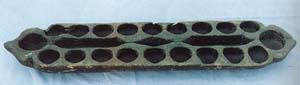
Congklak has its origins in either Africa or the Arab world, depending on which scholar's theory you choose to believe. Some of the oldest evidence was found in National Old congklak boardGeographic-sponsored archaeological diggings dating back to 7,000 to 5,000 BC in present-day Jordan. Excavations of a house uncovered a limestone slab with two parallel rows of circular depressions. The layout was easily recognizable to an archaeologist on the dig as the Congklak playing board. Murray, a noted scholar, traced the origins to ancient Egypt's Empire Age (about the 15th to 11th centuries BC). Many experts surmise that Congklak may in fact be the oldest board game ever.
The earliest recorded writings describing the game were found in references to mancala in Arab religious texts dating to the Middle Ages. Some scholars believe that the game originated in the Middle East and spread from there to Africa. Then, the game spread to Asia with Arab traders and came to the Caribbean around 1640 via the African slave trade. Other experts place the origins in Central Africa.
Girls playing on an elaborate congklak playing boardToday, the game is known by numerous names around the world. The names are taken from the local culture using words that reflect where the game is played, the manner of winning, the mode of play and the board or counters used. It is referred to in English as Count and Capture.
In Arab countries, the most common name is mancala (an Arabic word meaning in English “to move”). In some West African countries the depressions in the board are referred to as Warri or Awari, which means houses, thus giving it the name Wari. In Nigeria the game is known as Adi, which is also the name of the seeds used to play the game.
Due to its widespread popularity, enthusiasts have developed numerous web sites documenting various versions of the game. lists 279 names of the game found through their research. As you surf through these web sites, it's fascinating to see how each country or culture has its own customs relating to the making of the board, who can play, as well as how and when the game is played. Some sites feature on-line versions of the game as well, if you'd like to play with other enthusiasts around the world. On the topic of online congklak, it has been suggested that congklak inspired games may begin to appear in online casinos, which already offer traditional games such as sic bo and Baccarat.
The game is so popular that the British Museum's Museum of Mankind featured an exhibition of mancala, Wari and other Congklak playing boards in 1997.

Congklak in Indonesia

Even within Indonesia, Congklak is known by different names from region to region. The most common name, Congklak, is taken from the cowrie shell, which is commonly used to Playing Congklakplay the game. In Malaysia, the game is known as congkak, a name that is used in many Sumatran provinces as well. In Java, the game is known as Congklak, dakon, dhakon or dhakonan. In Lampung, the game is called, dentuman lamban. In Sulawesi, the game is referred to as Mokaotan, Maggaleceng, Aggalacang and Nogarata.
Historical references to Congklak refer to the game played by young girls of Javanese nobility. It is most likely that foreign traders, due to their close contact with the upper classes, introduced Congklak to them. With the passage of time, Congkla' s popularity grew until its now widely played by the common people as well. In most regions, Congklak play is limited to young girls, teens and women in their leisure time and its seen as a 'girl's game'. In only a few regions is Congklak played by men and boys as well.
In Sulawesi, historically, the game was reserved for play only during grieving periods, after the death of a loved one. It was considered taboo to play the game at any other time. In Central Java, in pre-historic times, Congklak was used by farmers to calculate the seasons, to know when to plant and harvest, as well as to predict the future.

Congklak Playing Board

The playing board is made from wood, with variations from island to island in the number ofCongklak playing boards can take on many shapes.holes on each side, either 5, 6, 7 or 9 holes. All the boards have two 'store house' holes, one on each end. The design varies from simple, unadorned woods, to boat-shaped boards, to highly decorated playing boards. In Central Java, elaborate designs utilizing the Javanese naga (dragon) are common. Dragons face out from both ends, with their tails decorating the side of the boards and legs suspending the board up off the floor. Congklak boards can be elaborately carved and painted, with gold and red being popular colors. Most, however, are made of relatively plain wood.
As in the archaeological find in Jordan, diggings in Mojokerto, Lamongan and Bondowoso in East Java have unearthed Congklak 'boards' with holes carved into large stones. These were found along with the broken pieces of temple stones and other archaeological remains of earlier times.
In Lampung, village children often play without a board, but instead create their own playing area by scooping out holes in the ground and collecting stones or seeds each time they want to play.

Playing Pieces

Not much has changed since prehistoric times, when Congklak was played with stones or seeds. In Indonesia, stones, seeds and shells are used to play the game, whatever is close Children in Indonesian villages enjoy the traditional game of congklakat hand. Near a beach shells may be used. Near rivers, the game may be played with smooth pebbles and in agricultural areas, seeds. Commonly used seeds are tamarind, kemiri, sawo and even corn kernels.
The widespread popularity of Congklak around the world can undoubtedly be attributed in part to the simplicity of the materials used to play the game. Congklak, in all its variations, continues to attract dedicated players as well as craftsmen, mathematicians, programmers and collectors of regional art and handicrafts.
Whatever version you play today, and by whatever name you call it, you'll find Congklak a challenging game of patience and skill.

Swimming - health benefits

  • Summary

    • As well as being fun, swimming is a great way to keep fit and well and make friends.
    • Swimming is a healthy activity that you can continue for a lifetime.
    • Swimming is a low-impact activity that has many physical and mental health benefits.
    • Make sure you know how to swim and do so in a safe environment.

  • Swimming is one of the most popular sports in Australia. Our nation is surrounded by water and swimming is one of our great passions. As well as being fun, swimming is a great way to keep fit, stay healthy and make friends. Swimming is a healthy activity that you can continue for a lifetime. It is a low-impact activity that has many physical and mental health benefits.

    Swimming for recreation

    Swimming is a great recreational activity for people of all ages. Recreational swimming can provide you with a low-impact workout and it’s also a good way to relax and feel good. Common swimming styles in recreational swimming are breaststroke, backstroke, side stroke and freestyle.

Competitive swimming

Some people who enjoy swimming want to take it to a competitive level. This can provide the health benefits of a vigorous workout as well as the fun and thrill of competition. The main strokes used in competitive swimming are breaststroke, freestyle, backstroke and butterfly. The distances swum in competition swimming can vary from 50 metres in a pool to much further distances in open water.

Health benefits of swimming

Swimming is a great workout because you need to move your whole body against the resistance of the water.

Swimming is a good all-round activity because it:
  • keeps your heart rate up but takes some of the impact stress off your body
  • builds endurance, muscle strength and cardiovascular fitness
  • helps maintain a healthy weight, healthy heart and lungs
  • tones muscles and builds strength
  • provides an all-over body workout, as nearly all of your muscles are used during swimming.

Other benefits of swimming

Swimming has many other benefits including:
  • being a relaxing and peaceful form of exercise
  • alleviating stress
  • improving coordination, balance and posture
  • improving flexibility
  • providing good low-impact therapy for some injuries and conditions
  • providing a pleasant way to cool down on a hot day
  • being available in many places – you can swim in swimming pools, beaches, lakes, dams and rivers. Make sure that the environment you choose to swim in is safe.

Getting started with swimming

Getting started in swimming is easy. It is a sport for all age groups, skill and fitness levels. Before you get started, you will need to purchase a pair of swimmers and some goggles. Goggles can be purchased for around $15 and upwards. 

There are public pools throughout Australia that are open to everyone. Entry to public pools usually costs a few dollars and many aquatic centres offer swimming lessons for people of all ages, as well as training and exercise groups. 

Some general tips for swimming

Before you dive in:
  • Make sure you know how to swim.
  • Choose a safe environment.
  • Warm up and stretch your muscles and joints before entering the water.
  • Have plenty of fluids on hand and drink regularly.
  • Don’t overdo it if you’re just starting out.
  • See your doctor if you haven’t exercised for a long time.

Things to remember

  • As well as being fun, swimming is a great way to keep fit and well and make friends.
  • Swimming is a healthy activity that you can continue for a lifetime.
  • Swimming is a low-impact activity that has many physical and mental health benefits.
  • Make sure you know how to swim and do so in a safe environment.

Friday, March 22, 2019

Hobby


A hobby is a regular activity done for enjoyment, typically during one's leisure time. Hobbies include collecting themed items and objects, engaging in creative and artistic pursuits, playing sports, or pursuing other amusements. Participation in hobbies encourages acquiring substantial skills and knowledge in that area. A list of hobbies changes with renewed interests and developing fashions, making it diverse and lengthy. Hobbies tend to follow trends in society, for example stamp collecting was popular during the nineteenth and twentieth centuries as postal systems were the main means of communication, while video games are more popular nowadays following technological advances. The advancing production and technology of the nineteenth century provided workers with more availability in leisure time to engage in hobbies. Because of this, the efforts of people investing in hobbies has increased with time.

Hobbyists may be identified under three sub-categories: casual leisure, serious leisure, and project-based leisure. Though, some hobbyists engage in leisure pursuits that overlap multiple boundaries of the groups. Hobbies are mostly found within the second category, serious leisure.
History
Hobbies were originally described as pursuits that others thought somewhat childish or trivial. However, as early as 1676 Sir Matthew Hale, in Contemplations Moral and Divine, wrote "Almost every person hath some hobby horse or other wherein he prides himself."[5] He was acknowledging that a "hobby horse" produces a legitimate sense of pride. By the mid 18th century there was a flourishing of hobbies as working people had more regular hours of work and greater leisure time. They spent more time to pursue interests that brought them satisfaction.[6] However, there was concern that these working people might not use their leisure time in worthwhile pursuits. "The hope of weaning people away from bad habits by the provision of counter-attractions came to the fore in the 1830s, and has rarely waned since. Initially the bad habits were perceived to be of a sensual and physical nature, and the counter attractions, or perhaps more accurately alternatives, deliberately cultivated rationality and the intellect."[7] The flourishing book and magazine trade of the day encouraged worthwhile hobbies and pursuits. The burgeoning manufacturing trade made materials used in hobbies cheap and was responsive to the changing interests of hobbyists.

The English have been identified as enthusiastic hobbyists, as George Orwell observed. "[A]nother English characteristic which is so much a part of us that we barely notice it … is the addiction to hobbies and spare-time occupations, the privateness of English life. We are a nation of flower-lovers, but also a nation of stamp-collectors, pigeon-fanciers, amateur carpenters, coupon-snippers, darts-players, crossword-puzzle fans. All the culture that is most truly native centres round things which even when they are communal are not official—the pub, the football match, the back garden, the fireside and the 'nice cup of tea'."[8]

Deciding what to include in a list of hobbies provokes debate because it is difficult to decide which pleasurable pass-times can also be described as hobbies. During the 20th century the term hobby suggested activities, such as stamp collecting, embroidery, knitting, painting, woodwork, and photography. Typically the description did not include activities like listening to music, watching television, or reading. These latter activities bring pleasure, but lack the sense of achievement usually associated with a hobby. They are usually not structured, organised pursuits, as most hobbies are. The pleasure of a hobby is usually associated with making something of value or achieving something of value. "Such leisure is socially valorised precisely because it produces feelings of satisfaction with something that looks very much like work but that is done of its own sake."[4] "Hobbies are a contradiction: they take work and turn it into leisure, and take leisure and turn it into work."[9]

Hobbies change with time. In the 21st century, the video game industry is a very large hobby involving millions of kids and adults in various forms of 'play'. Stamp collecting declined along with the importance of the postal system. Woodwork and knitting declined as hobbies, because manufactured goods provide cheap alternatives for handmade goods. Through the internet, an online community has become a hobby for many people; sharing advice, information and support, and in some cases, allowing a traditional hobby, such as collecting, to flourish and support trading in a new environment.

Hobbyists
Hobbyists are a part of a wider group of people engaged in leisure pursuits where the boundaries of each group overlap to some extent. The Serious Leisure Perspective[10] groups hobbyists with amateurs and volunteers and identifies three broad groups of leisure activity with hobbies being found mainly in the Serious leisure category. Casual leisure is intrinsically rewarding, short-lived, pleasurable activity requiring little or no preparation. Serious leisure is the systematic pursuit of an amateur, hobbyist, or volunteer that is substantial, rewarding and results in a sense of accomplishment. Finally, project-based leisure is a short-term often a one-off project that is rewarding.[11]

The terms amateur and hobbyist are often used interchangeably. Stebbins[10] has a framework which distinguishes the terms has a useful categorisation of leisure in which he separates casual leisure from serious Leisure. He describes serious leisure as undertaken by amateurs, hobbyists and volunteers. Amateurs engage in pursuits that have a professional counterpart, such as playing an instrument or astronomy. Hobbyists engage in five broad types of activity: collecting, making and tinkering (like embroidery and car restoration), activity participation (like fishing and singing), sports and games, and liberal-arts hobbies (like languages, cuisine, literature). Volunteers commit to organisations where they work as guides, counsellors, gardeners and so on. The separation of the amateur from the hobbyist is because the amateur has the ethos of the professional practitioner as a guide to practice. An amateur clarinetist is conscious of the role and procedures of a professional clarinetist.

A large proportion of hobbies are mainly solitary in nature.[12] However, individual pursuit of a hobby often includes club memberships, organised sharing of products and regular communication between participants. For many hobbies there is an important role in being in touch with fellow hobbyists. Some hobbies are of communal nature, like choral singing and volunteering.

People who engage in hobbies have an interest in and time to pursue them. Children have been an important group of hobbyists because they are enthusiastic for collecting, making and exploring, in addition to this they have the leisure time that allows them to pursue those hobbies. The growth in hobbies occurred during industrialisation which gave workers set time for leisure. During the Depression there was an increase in the participation in hobbies because the unemployed had the time and a desire to be purposefully occupied.[13] Hobbies are often pursued with an increased interest by retired people because they have the time and seek the intellectual and physical stimulation a hobby provides.

Types of hobbies
For a more comprehensive list, see List of hobbies.
Hobbies are a diverse set of activities and it is difficult to categorize them in a logical manner. The following categorization of hobbies was developed by Stebbins.[11]

Collecting
Collectable Antique Antiquities
Terms
Ephemera Premium Prize Souvenir Special edition
Topics
List of collectables List of hobbies
vte
Collecting
[additional citation(s) needed]

Main article: Collecting
Collecting includes seeking, locating, acquiring, organizing, cataloging, displaying and storing.[14] Collecting is appealing to many people due to their interest in a particular subject and a desire to categorise and make order out of complexity. Some collectors are generalists, accumulating items from countries of the world. Others focus on a subtopic within their area of interest, perhaps 19th century postage stamps, milk bottle labels from Sussex, or Mongolian harnesses and tack, Firearms (both modern and vintage).

text
A stamp album used in stamp collecting.
Collecting is an ancient hobby, with the list of coin collectors showing Caesar Augustus as one. Sometimes collectors have turned their hobby into a business, becoming commercial dealers that trade in the items being collected.

An alternative to collecting physical objects is collecting records of events of a particular kind. Examples include train spotting, bird-watching, aircraft spotting, railfans, and any other form of systematic recording a particular phenomenon. The recording form can be written, photographic, online, etc.

Making and tinkering

This section does not cite any sources. Please help improve this section by adding citations to reliable sources. Unsourced material may be challenged and removed. (November 2017) (Learn how and when to remove this template message)
Making and tinkering includes working on self-motivated projects for fulfillment. These projects may be progressive, irregular tasks performed over a long period of time.[11] Making and Tinkering hobbies include higher-end projects, such as building or restoring a car or building a computer from individual parts, like CPUs and SSDs. For computer savvy do-it-yourself hobbyists, CNC (Computer Numerical Control) machining may also popular. A CNC machine can be assembled and programmed to make different parts from wood or metal.

Tinkering is 'dabbling' with the making process, often applied to the hobby of tinkering with car repairs, and various kinds of restoration: of furniture, antique cars, etc. It also applies to household tinkering: repairing a wall, laying a pathway, etc. Examples of Making and Tinkering hobbies include Scale modeling, model engineering, 3D printing, dressmaking, and cooking.

Scale modeling is making a replica of a real-life object in a smaller scale and dates back to prehistoric times with small clay "dolls" and other children's toys that have been found near known populated areas. The Persians, Greeks, and Romans took the form to a greater depth during their years of domination of the Western World, using scale replicas of enemy fortifications, coastal defense lines, and other geographic fixtures to plan battles.[citation needed]

At the turn of the Industrial Age and through the 1920s, families could afford things such as electric trains, wind-up toys (typically boats or cars) and the increasingly valuable tin toy soldiers. Scale modeling as we know it today became popular shortly after World War II. Before 1946, children as well as adults were content in carving and shaping wooden replicas from block wood kits, often depicting enemy aircraft to help with identification in case of an invasion.

With the advent of modern plastics, the amount of skill required to get the basic shape accurately shown for any given subject was lessened, making it easier for people of all ages to begin assembling replicas in varying scales. Superheroes, aeroplanes, boats, cars, tanks, artillery, and even figures of soldiers became quite popular subjects to build, paint and display. Although almost any subject can be found in almost any scale, there are common scales for such miniatures which remain constant today.

Model engineering refers to building functioning machinery in metal, such as internal combustion motors and live steam models or locomotives. This is a demanding hobby that requires a multitude of large and expensive tools, such as lathes and mills. This hobby originated in the United Kingdom in the late 19th century, later spreading and flourishing in the mid-20th century. Due to the expense and space required, it is becoming rare.


A coffee-table sized model railroad
3D Printing is a relatively new technology and already a major hobby as the cost of printers has fallen sharply. It is a good example of how hobbyists quickly engage with new technologies, communicate with one another and become producers related to their former hobby. 3D modeling is the process of making mathematical representations of three dimensional items and is an aspect of 3D printing.

Dressmaking has been a major hobby up until the late 20th century, in order to make cheap clothes, but also as a creative design and craft challenge. It has been reduced by the low cost manufactured clothes.

Cooking may be both a hobby or job. is for some people an interest, a hobby, a challenge and a source of significant satisfaction. For many other people it is a job, a chore, a duty, like cleaning. In the early 21st century the importance of cooking as a hobby was demonstrated by the high popularity of competitive television cooking programs.

Activity participation
Activity participation includes partaking in "non-competitive, rule-based pursuits."[11]


This section does not cite any sources. Please help improve this section by adding citations to reliable sources. Unsourced material may be challenged and removed. (November 2017) (Learn how and when to remove this template message)
Main article: Outdoor recreation
Outdoor pursuits are the group of activities which occur outdoors. These hobbies include gardening, hill walking, hiking, backpacking, cycling, canoeing, climbing, caving, fishing, hunting, Target shooting (informal or formal), wildlife viewing (as birdwatching) and engaging in watersports and snowsports.

Depending on an individual's desired level of adrenaline, outdoors experiences are considered one type of hobby. While many enjoy an adrenaline rush or just an escape from reality, outdoor recreational activities can also be an extremely effective medium in education and team building.[15]

As interest increases, so has the desire for commercial outdoor pursuits. Outdoor recreational supply stores have opened in large numbers and are thriving, as have outdoor pursuit journalism and magazines, both on paper and the Internet.

The increased accessibility of outdoor pursuit resources has been the source of some negative publicity over the years, with complaints of the destruction of landscape. An example is the destruction of hillsides as footpaths are eroded due to an excessive number of visitors.


This section does not cite any sources. Please help improve this section by adding citations to reliable sources. Unsourced material may be challenged and removed. (November 2017) (Learn how and when to remove this template message)
Main article: Gardening

Gardening
Residential gardening most often takes place in or about one's own residence, in a space referred to as the garden. Although a garden typically is located on the land near a residence, it may also be located on a roof, in an atrium, on a balcony, in a windowbox, or on a patio or vivarium.

Gardening also takes place in non-residential green areas, such as parks, public or semi-public gardens (botanical gardens or zoological gardens), amusement and theme parks, along transportation corridors, and around tourist attractions and hotels. In these situations, a staff of gardeners or groundskeepers maintains the gardens.


A variety of flowers and vegetables in an indoor garden.
Indoor gardening is growing houseplants within a residence or building, in a conservatory, or in a greenhouse. Indoor gardens are sometimes incorporated into air conditioning or heating systems.

Water gardening is growing plants that have adapted to pools and ponds. Bog gardens are also considered a type of water garden. These all require special conditions and considerations. A simple water garden may consist solely of a tub containing the water and plant(s).

Container gardening is concerned with growing plants in containers that are placed above the ground.

Liberal arts pursuits

This section does not cite any sources. Please help improve this section by adding citations to reliable sources. Unsourced material may be challenged and removed. (March 2019) (Learn how and when to remove this template message)
Main article: Liberal arts education
Main article: The arts

An amateur magician performing.
Many hobbies involve performances by the hobbyist, such as singing, acting, juggling, magic, dancing, playing a musical instrument, martial arts and other performing arts.

Some hobbies may result in an end product. Examples of this would be woodworking, photography, moviemaking, jewelry making, software projects such as Photoshopping and home music or video production, making bracelets, artistic projects such as drawing, painting, writing..., Cosplay (design, creation, and wearing a costume based on an already existing creative property), creating models out of card stock or paper – called papercraft. Many of these fall under the category visual arts.

Reading, books, ebooks, magazines, comics, or newspapers, along with browsing the internet is a common hobby, and one that can trace its origins back hundreds of years. A love of literature, later in life, may be sparked by an interest in reading children's literature as a child. Many of these fall under the category literary arts.

Sports and games
Main article: Sport
Main article: Game
Stebbins[11] distinguishes an amateur sports person and a hobbyist by suggesting a hobbysist plays in less formal sports, or games that are rule bound and have no professional equivalent. While an amateur sports individual plays a sport with a professional equivalent, such as football or tennis. Amateur sport may range from informal play to highly competitive practice, such as deck tennis or long distance trekking.